Tuesday, 8 October 2013

Experiment 2. Week 2 Independent Study

Progress in Max- remodeling Barcelona Pavilion


Material Research

1. Concrete
http://www.arroway-textures.com/files/gallery/1/demoscene_concrete-30.jpg
The basic concrete mix is formed from combining Portland Cement, water and rock. It is one of the most used material for buildings, bridges, tunnels and dams because of its strength and durability. Concrete gains strength over time and it is not weakened by moisture, mould or pests. A good example showing the strength and durability of concrete is the Roman Colosseum that was built nearly two thousand years ago and it is still standing firm now. This building material can last to about 50, 000 years. This building material is compact and non-porous and the fact that it does not lose its properties over time is considered low maintenance. Other than that, being naturally fire-resistant, concrete forms a highly effective barrier to fire spread. Although there are many benefits of using concrete, cracking has always been an issue and the reasons that cracking occur are drying shrinkage, thermal contraction, subgrade settlement and applied loads. One of the leading causes of deterioration of concrete is the corrosion of reinforcing steel and other embedded metals. Prevention can be taken to reduce or eliminate cracking in concrete and one of them is making sure that the concrete is properly placed, consolidate, finish and cured.

2. Glass


http://humanitiesunderground.wordpress.com/2011/05/30/glass-consciousness/

Glass is made by melting a mixture of silica in the form of sand and other minerals such as sodium carbonate, limestone, magnesium carbonate and additives in a furnace of 1700 degrees. Whilst still molten, glass can be manipulated into different shapes and forms. Glass is also a material used in the building construction. The benefits of using glass in construction is because of its high chemical resistance, a strong building material. However, it is a poor conductor of electricity and can be a problem for fire-resistance. Glass, overtime will crack and break due to several factors. One of them is due to the changes in temperature and wind deflects, causing glass to expand and contract and if insufficient space for glass to expand, it binds against the frame and causes breakage as a result.

3. Marble


http://www.essentialingredient.com.au/featured/marble-boards/
Marble is formed as a result of re-crystallization of limestone under pressure and heat of geologic processes. There are two types of marble, one composed of calcite and the other of dolomite. Calcite marble is less resistant to acid attack as compared to dolomitic marble. Marbles are normally polished and they are popular decorative stones for architectural uses. Marble deteriorates due to exposure to the weather and other natural effects such as wind, rain and change in temperature. This causes the marble to lose its polish and detailing. Another condition that the marble will face is crumbling. This may be cause by the source of salt migration and this weakens the strength and durability of the marble and causes it to crumble.

Reference
Cement Sustainability Initiative 2013, <http://www.wbcsdcement.org/index.php/key-issues/sustainability-with-concrete/properties-of-concrete>.

GSA 2012,< http://www.gsa.gov/portal/content/111858>.

Portland Cement Association 2013, <http://www.cement.org/tech/faq_cracking.asp>.

Viridian, 2011, <http://glasstalks.com/2011/03/16/physicalproperties/>.


Reflection

This week we learnt about material and looked at formwork. Structure and materials are really important as to what is placed and where the location of the building is cause it might caused damage. One really interesting event mentioned was a building in London melted a car. And I did a little reading on it, the Walkie Talkie skyscraper reflections melted the side mirror of a jaguar car. And this is due to the concave of its design. This has made me more aware of the choice of materials and the considerations that should be concerned, such as sunlight.

Experiment 2. Week 2 Task

Using Crazybump

The brick looks darker
Before Crazybump

Using Crazybump

After Crazybump


After researching on the three buildings last week, the house that I've chosen is the Barcelona Pavilion.


Monday, 7 October 2013

Experiment 2. Week 1 Independent Study

1. Export Process attempt#2


Issues: The material seems to be working a little better compared to the attempts in class. However, it still fails to be properly assigned in CryEngine.

Attempt #3- Succeeded at last


Research

1. Barcelona Pavilion by Mies Van Der Rohe, 1929

Credits: Bruno Struck
http://www.GreatBuildings.com/cgi-bin/gbi.cgi/Barcelona_Pavilion.html/cid_1195531959_mies_pavilion_out.jpg

The Barcelona Pavilion was intended as "a symbol for a nation that had reinvented itself- as what is historically known as the Weimar Republic- after the social and cultural upheaval of the First World War". (Unwin, 2010)

The seminal character of the Barcelona Pavilion is the rule of asymmetry, with elements placed on an axis. The first move was to create a platform, and subsequent elements arranged on the horizontal surface of the platform. One of the significance is the flat rectangular roof, floating parallel to the platform's top surface. Mies also uses solid wall and most of them wrapped around the edge of the platform. To differentiate the zones on the platform, Mies reserved the onyx, the rarest and most valuable stone to clad the 'altar' wall. Other materials used were marble, steel, chrome, tinted glass, double wall of translucent white glass, polished stone walls. 

2. Rudin House by Herzog & de Meuron, 1997

Credits: Apartment Therapy
http://www.apartmenttherapy.com/rudin-house-by-herzog-de-meuro-55630
The Rudin House is located at the foot of a hill within a conventional central European private urbanisation in the city of Leymen, Upper Rhine, France. The house is a heavy concrete mass and the exterior is mostly concrete but set up on stilts. The house gives a feeling of simplicity yet modern at the time. The house, unlike houses near the area, looks like a floating house with the platform lifted or raised from the ground. 

3. Maison Bordeaux by Rem Koolhaas, 1998

Credits: Beka & Lemoine
http://we-make-money-not-art.com/archives/2008/11/koolhaas-houselife-is-a-film.php#.UlTTOyiDqfQ
This house was designed for a client confined to a wheelchair. It incorporates a hydraulic platform and it moves between the levels of the house. Having said that, only when the client is on the level, the level is complete. The house consists of three levels; the lower level sits as a heavy mass carved into the hill, the highest volume is looks as if it is floating on the middle volume because of the transparent glass and cantilevering it over it and the cantilevering volume supported by a steel tube and there is an L-shaped braces supporting the back of the house. 

References:
Apartment Therapy 2013: http://www.apartmenttherapy.com/rudin-house-by-herzog-de-meuro-55630

Kroll A 2011, AD Classics: Maison Bordeaux, http://www.archdaily.com/104724/ad-classics-maison-bordeaux-oma/

Unwin S 2010, Barcelona Pavilion, Twenty Buildings Every Architect Should Understand, Routledge, pp.25-42.

Reflection
Life after People.

This week, videos related to what experiment 2 were shown and these includes Abandoned city, Ukraine and Hashima Island which used to be a coal mining town. I was fascinated to see how different materials react after a period of time and I thought that if I want to make my building in Cryengine decay, studying the material is really important so that it will be more realistic in cryengine.

Some research I did myself, and I found this website showing places abandoned by humans.

13 Hauntingly Beautiful Places Abandoned by Humans


this particularly interests me
The Hotel del Salto in Columbia opened in 1928


I would probably think of my building in the jungle, near the beach overtaken by nature because of the moisture and environment in my crysis environment.

Experiment 2. Week 1 Task

1. Completed the 3ds Max 2012 to CryENGINE3 video tutorial.
2. Post an image of the resulting exported objects in CryEngine to your blog.


Creating Materials in Max

Assigning materials

Exporting Materials to Sandbox

Assigning materials in material editor

Export the model from Max

Exported Objects in CryEngine


Friday, 13 September 2013

Experiment 1 Submission

The Island


Strategy Statement
My letter and number combination is G and 5. The strategy I am using is to have G and 5 as the shape of my island as the largest(the macro) of 5 scales and I did that using geocontrol2. In scene 1, The Cliff, I used decals to darken the surface and that part forms my combination. Another strategy is to use vegetation (river trees and rocks) to form the combination, this scale is most visible at certain angles from the top view and is held in Scene 2. In scene 3, is The Park inspired by Clumber Park and I have places my micro scale there with 5 units of mushrooms and concealing the G in the terrain. In scene 4, the scale is the second largest macro scale, because I have shaped the coast in the shape of 5 and planted footpaths to form the g. Scene 5 is where I revealed my number in forms of shadow. 


5X images of draft and final cryengine3 environment

Scene 1- The Cliff
Sublime


Scene 2


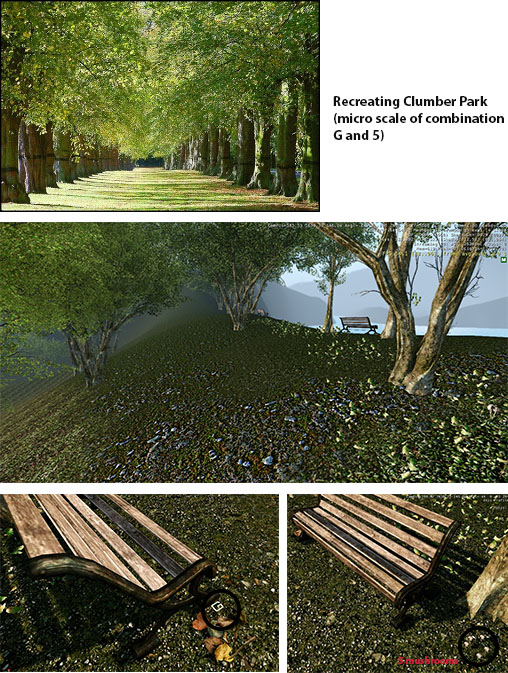
Scene 3- The Park
(micro scale of G and 5)
This scene is inspired by Capability Brown's Clumber Park. I have planted trees on both sides to create a path in the middle. On the side there are benches for people to rest and able to look across the river, the sandy beach and the grand cliff.

The micro scale combination is places next to the first bench, with G that looks similar to the grass surface and 5 mushrooms near the tree beside the bench that provides shade.


Scene 4- The Coast


Scene 5- The Forest
Subliminal
Using shadow to create my combination, at 4pm late afternoon, you can see five shadows in the forest scene, and the placement of rocks create the letter g.


Video Trailer- Galletea Island

It is named Galletea because G is my letter.
Shows a day in the island, discovering different places in the island.


Crysis environment and file


Weekly Progress
Week 1: tasks
Week 2: tasks
Week 4 The Sublime: In-class and independent study
Week 5 The Subliminal: In-class and independent study
Week 7: Reflection and submission week

Tuesday, 10 September 2013

Week 7- Reflection.

Reflection and submission week

In the lecture, examples of setting up camera was taught and it is quite applicable to my island. I thought of the places that I would like to show in my trailer and also, naming the entities in the level is really important because it is easier for me to look for my objects and to hide them. In tutorial, Stephen Davey made sure we understood what strategy statement really is, and that cleared things up for me as I now clearly list how i reveal and conceal my combination of G and 5 clearly in the strategy statement.

Friday, 6 September 2013

Week 6 Independent Study

Reflection
In lecture today, some mpvies were mentioned, such as Jaws and Inception and to make things more realistic, flowgraphs can help make the scenes look real. And also, I thought of the what I want to show in my trailer, and the outcome is to take a day tour in my island. Since my letter is G, i shall name my island Galletea. I want to bring the audience to different places of my island, which consist of, The Cliff, The Coast, The Park, and the Forest. The music will be relaxing and carefree, just like having a day trip.


For my independent study, I followed the Sony Vegas tutorial on how to edit my video using that software.

The trial version that I am using to edit my video is Vegas Pro 12.